Forms Download
 Funds Comparison
 Access Online Application Form
 Account Opening
 Risk Tolerance Test
 SSF/ RMF/ Thai ESG/ LTF/ Withholding Tax Certificates
 Tax Exemption Request for SSF/RMF/Thai ESG/Thai ESGX
 @ccess online
 Provident Fund (PVD)
ข่าว/ประกาศกองทุน
Promotions/Fund Highlight
KFGDC | KF-GDCRMF: Conservative Asset Mix for Global Opportunities.
IPO: 3 – 10 November 2026
KFGDC | KF-GDCRMF: Conservative Asset Mix for Global Opportunities.
Complete the multi-asset fund series for investors with a moderate risk appetite with KFGDC, a new fund offering global exposure across a wide range of asset classes through the master fund, Allianz Dynamic Multi Asset Strategy SRI 30. The fund’s strategy emphasizes flexible asset allocation and portfolio adjustments, aiming to balance growth opportunities with volatility while incorporating sustainable investing principles (SRI) to pursue long-term investment returns.
IPO: 3–10 November 2026 | Minimum Investment: THB 500.
- KFGDC: Krungsri Global Dynamic Conservative Allocation SRI Fund
- KF-GDCRMF: Krungsri Global Dynamic Conservative Allocation SRI Retirement Mutual Fund
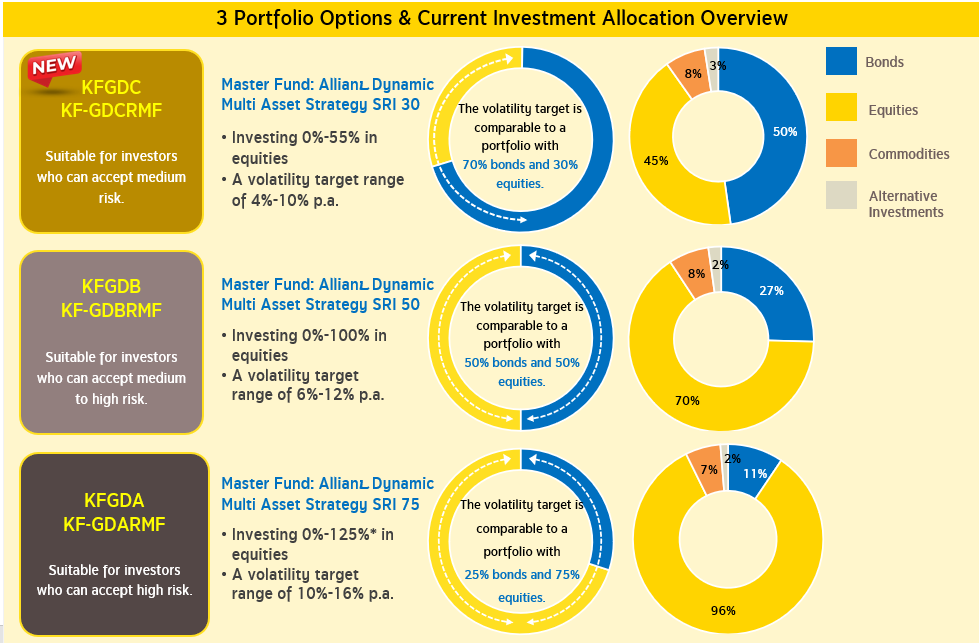
Source: Allianz Global Investors, as of Sep 2026. The investment strategy does not guarantee returns and may result in losses. The fund management team reviews the asset allocation and expected volatility target annually. The equity allocation of Allianz Dynamic Multi Asset Strategy SRI 75 may be increased to a maximum of 125% through the use of derivatives.
Why Invest in KFGDC / KF-GDCRMF?
- Global Investment Expertise: Access global investment opportunities through a master fund managed by a team of multi-asset investment specialists.
- Diversified Opportunities in a Single Fund: Invest across a wide range of asset classes and regions to diversify return sources and reduce reliance on any single market.
- Flexibility Across Market Conditions: Adjust asset allocation in response to changing opportunities and risks, helping the portfolio adapt to a variety of market conditions.
- Balancing Growth Opportunities and Risk: Target a volatility range of 4–10% per annum, comparable to a portfolio comprising 30% equities and 70% fixed income, while incorporating Sustainable and Responsible Investment (SRI) principles.
Master Fund: Allianz Dynamic Multi Asset Strategy SRI 30
1. Dynamic Multi-Asset Strategy: The strategy combines two complementary portfolio components to balance core investments with additional opportunities based on prevailing market conditions.
- Core Portfolio: The core investment portfolio, designed to provide balance to the overall portfolio.
- Satellite Portfolio: Investments in selected assets and themes that offer potential additional returns based on investment views.
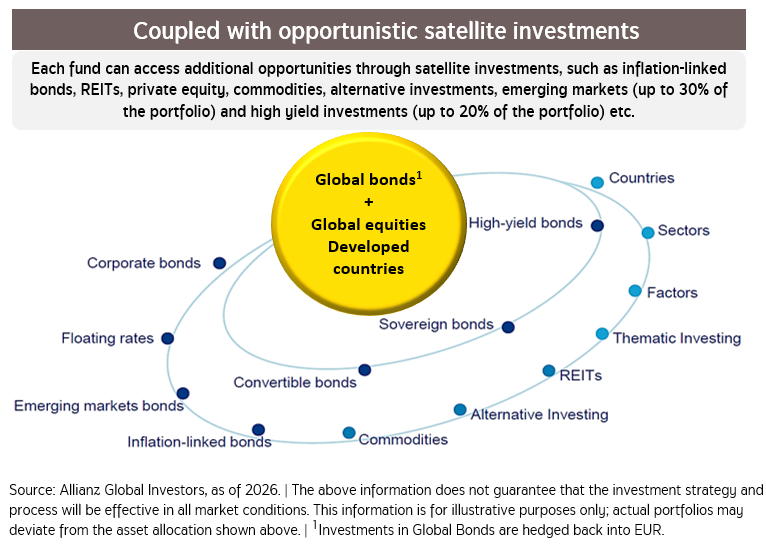
The master fund can adjust its equity allocation within a range of 0–55%. Investment decisions are supported by fundamental analysis, quantitative analysis, and ongoing risk management.
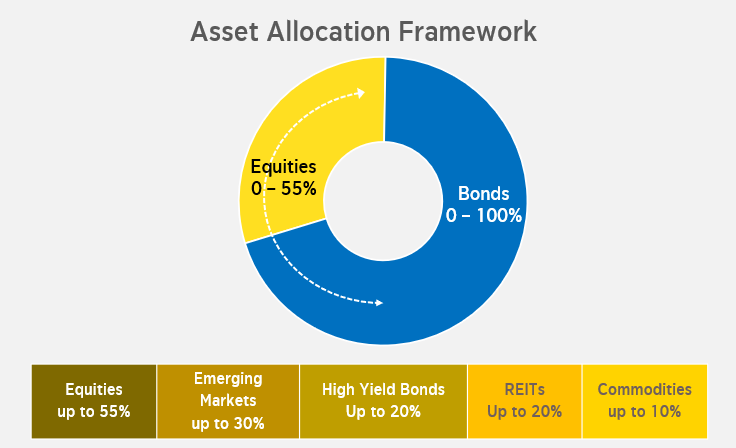
Source: Allianz Global Investors, as of Sep 2026. Investment returns are not guaranteed, and the strategy may incur losses.
Examples of Satellite Portfolio Investment Strategies: The Satellite Portfolio seeks opportunities in potentially attractive assets across a range of regions and investment themes.
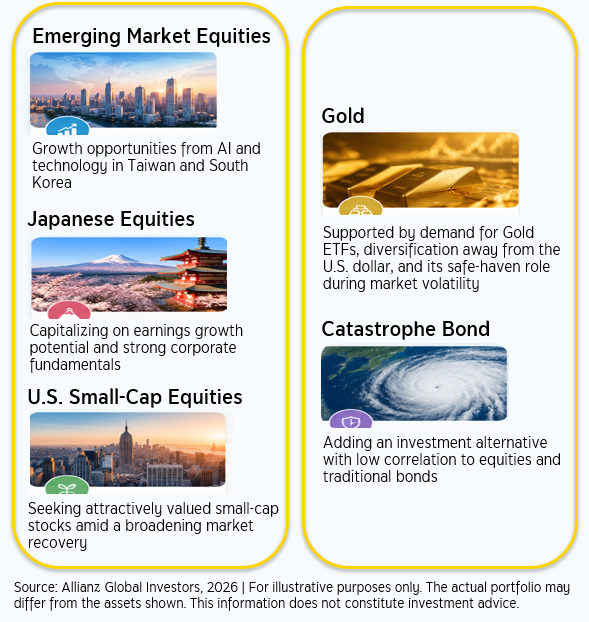
2. Key Pillars of a Differentiated Investment Portfolio
- Fundamental Analysis: A team of more than 75 investment professionals analyzes markets and assets to support investment decisions.
- Systematic Analysis: Quantitative analysis is used to assess markets and identify medium-term investment opportunities.
- Risk Management: Portfolio volatility and risk are continuously monitored to keep them within the defined parameters.
3. Integrating Sustainability Through a Best-in-Class SRI Approach
The master fund emphasizes quality security selection while incorporating sustainability considerations through the following key processes:
- Comprehensive Screening: Investments must meet both fundamental and sustainability criteria.
- Prioritizing ESG Leaders: Focus on securities with ESG scores that outperform their peers within the same industry.
- Excluding the Lowest-Rated Securities: Exclude securities ranked at the bottom of their peer groups in terms of sustainability performance (Worst-in-Class).

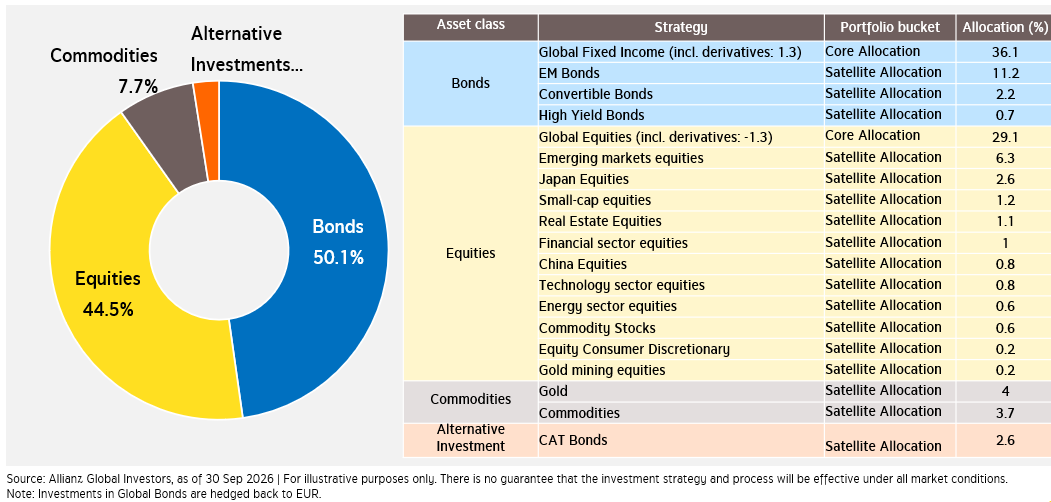
4. Diversified Portfolio Across Asset Classes
The current portfolio is diversified across multiple asset classes, seeking opportunities under different market conditions. It selects from more than 600 securities across equity and fixed-income markets.
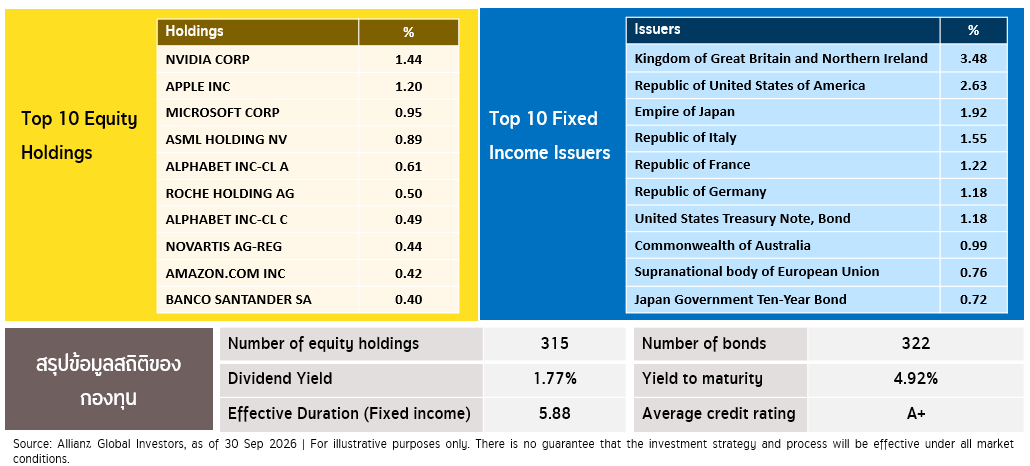
5. A Consistent Track Record of Strong Performance reflects the distinctive investment strategy.
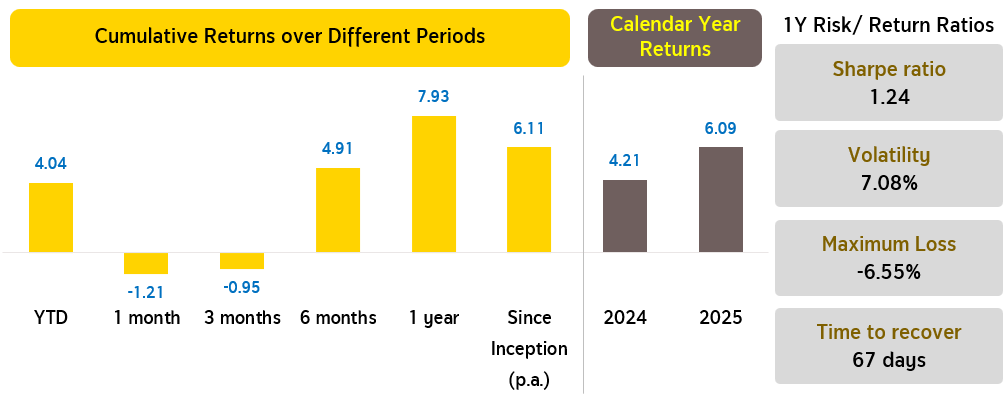
Source: Allianz Global Investors, as of 30 Sep 2026. The 1-year Risk/Return Ratio data is as of 31 Aug 2026. The performance shown is that of the master fund's Class A EUR, while KFGDC and KF-GDCRMF invest in Class P EUR, which follows the same investment policy. Returns are based on NAV prices after fees, excluding subscription and redemption fees, with reinvestment of dividends. The Sharpe ratio compares a fund's return relative to its risk, measured as the excess return over the risk-free rate. Volatility measures the fluctuation in investment returns over the specified period. The performance shown is that of the master fund and is not calculated in accordance with the mutual fund performance measurement standards of the Association of Investment Management Companies (AIMC).
Key Fund Information: KFGDC / KF-GDCRMF
- Investment Policy: Invest at least 80% of NAV, on average over a fiscal year, in Allianz Dynamic Multi Asset Strategy SRI 30, Class P (EUR).
- Risk Level 5: Moderately High Risk. Foreign Exchange Risk Management: Both funds may hedge foreign exchange risk at the fund manager's discretion.
Disclaimers
- Retirement Mutual Funds (RMFs) are designed to encourage long-term retirement savings. Investors should understand the product characteristics, return conditions, and investment risks, and review the investment guide for tax benefits before making an investment decision. Past performance of mutual funds does not guarantee future results.
- This document has been prepared using information from various sources considered reliable as of the stated date. However, the Company cannot guarantee the accuracy, reliability, or completeness of all information and reserves the right to change any information without prior notice.
- KFGDC and KF-GDCRMF are subject to foreign exchange risk, which may result in gains or losses from exchange rate movements and/or the return of an amount less than the initial investment.
- Credit Card Promotion: Investments made using credit cards are not eligible for credit card promotional offers.
- Tax Benefits for RMF Investors: Investors should review the tax benefits and conditions specified in the investment guide. Investors who fail to comply with the investment conditions will not be entitled to the tax benefits and must repay previously received tax benefits within the prescribed period. Otherwise, additional payments and/or penalties may apply under the Revenue Code.
Compare Krungsri’s Multi-Asset Fund Series
KFGDC | KFGDB | KFGDA
Different return opportunities to suit different risk appetites.
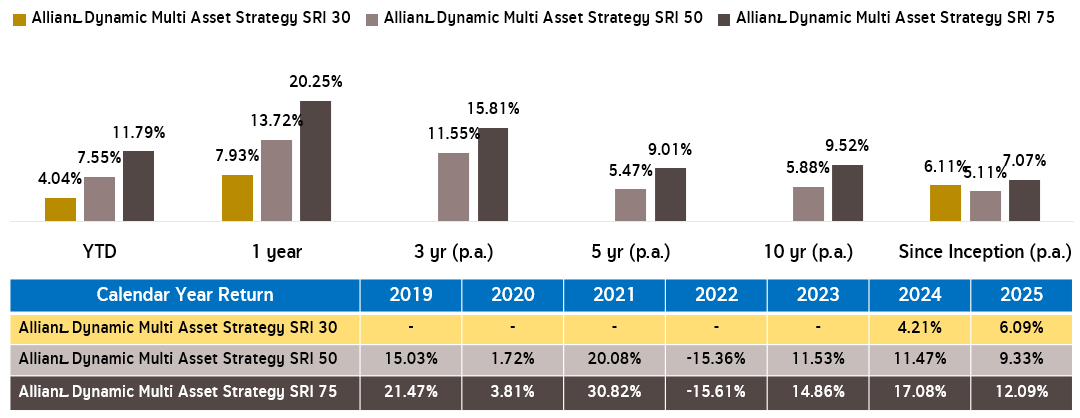
Source: Allianz Global Investors, as of 30 Sep 2026. The performance shown is that of the master fund's Class A EUR, while the funds invest in Class P EUR, which follows the same investment policy. Returns are based on NAV prices after fees, excluding subscription and redemption fees, with reinvestment of dividends. The performance shown is that of the master fund and is not calculated in accordance with the mutual fund performance measurement standards of the Association of Investment Management Companies (AIMC).
Different return opportunities to suit different risk appetites.
Source: Allianz Global Investors, as of 30 Sep 2026. The performance shown is that of the master fund's Class A EUR, while the funds invest in Class P EUR, which follows the same investment policy. Returns are based on NAV prices after fees, excluding subscription and redemption fees, with reinvestment of dividends. The performance shown is that of the master fund and is not calculated in accordance with the mutual fund performance measurement standards of the Association of Investment Management Companies (AIMC).
Sustainability-Related Investment Risks
Thai Funds
1. Sustainability Factors Affecting Investments
1. Sustainability Factors Affecting Investments
1. Sustainability Factors Affecting Investments
- As the fund focuses on investing in a master fund that follows a specific investment strategy and invests in assets that promote sustainability, it may miss opportunities to invest in other master funds with broader investment universes that are not concentrated in securities aligned with a sustainability-focused investment strategy.
- Negative factors affecting assets aligned with the sustainability strategy, which the master fund emphasizes, may adversely affect the fund's performance due to the master fund's focus on such securities.
- The master fund applies internal criteria to select sustainable securities. Assessing whether an issuer meets these criteria requires information from external data providers, and such information may be incomplete or inaccurate.
- Assets held by the master fund may no longer meet its sustainability investment criteria and may need to be sold, potentially affecting the master fund's net asset value (NAV).
1. Sustainability Factors Affecting Investments
- The master fund's investment performance may be affected by and/or exposed to sustainability risks. A sustainability-focused investment strategy may cause the fund to miss opportunities to purchase certain securities that could otherwise generate attractive returns and/or require the sale of securities due to their characteristics, potentially resulting in lost investment opportunities.
- The master fund's sustainability-focused investment strategy may use data from one or more external research and data providers, as well as internal analysis. The criteria applied and the methodologies used may differ across funds.
- Funds implementing sustainability-focused investment strategies concentrate on sustainable assets and may have a narrower investment universe. This may limit diversification compared with funds that invest more broadly across different assets.
- Negative factors affecting assets aligned with the sustainability strategy, which the master fund emphasizes, may adversely affect the master fund's performance due to its concentration in such securities.
- The master fund applies internal criteria to select sustainable securities. Assessing whether an issuer meets these criteria requires information from external data providers, and such information may be incomplete or inaccurate.
- Assets held by the master fund may no longer meet its sustainability investment criteria and may need to be sold, potentially affecting the master fund's net asset value (NAV).